
Dunklin County Arrest Records and Charges
Dunklin County arrest records begin with law enforcement. An arrest report or booking-related record may identify the person arrested, the agency involved, the date or location, the alleged offense, and custody or bond details when those fields are open. In Dunklin County, the Sheriff's Office and jail operate from the Justice Center at 1175 Floyd Street, with the jail phone listed as 573-888-4010 and dispatch listed as 573-888-2409. City police departments, such as Kennett Police, may also create arrest or incident records before a case reaches court.
Court charge records begin at a different point. Law enforcement may arrest a person or submit reports, but the Dunklin County Prosecuting Attorney decides whether and what charges are filed in state criminal court. The official prosecutor page names Nicholas Jain as Prosecuting Attorney and links users to Missouri Case.net. Once a complaint, information, or other charging paper is filed, the charge appears as part of the court case record maintained by the Circuit Clerk.
The jail channel answers current custody questions. The court channel answers filed-charge, hearing, plea, disposition, and sentence questions. Current custody details fit better on the Dunklin County inmate records page, while the full criminal case outcome belongs with Dunklin County criminal court records.
Dunklin Court Charges After Arrest
The charge record is the key bridge between an arrest and a criminal case. After an arrest, a police report or sheriff report may be sent for prosecutor review. The prosecutor may file the same alleged offense, file a different charge, add counts, decline prosecution, or wait for more information. The court record starts when the filed charge reaches the clerk and receives a case number.
The Dunklin County Prosecuting Attorney page lists the office at 1175 Floyd Street, Kennett, MO 63857, phone 573-888-6676, and weekday office hours. It also references restitution, the Dunklin County Law Enforcement Restitution Fund, delinquent state tax payments, and a Case.net quick link. Those details support the local path: prosecutor review creates the filed charge, but public case lookup and court-copy requests move through Case.net and the Circuit Clerk once the case is filed.
Arrest-to-charge flow: Arrest or citation › booking or report › prosecutor review › complaint, information, or indictment › court case number › docket, plea, disposition, and sentence.
Find Dunklin Arrest Records
There is no official Dunklin County online jail roster or arrest-blotter link in the county research. That means the access path is practical rather than portal-only. For current custody, call the jail. For after-hours routing, call dispatch. For a public arrest report or incident report, make a request to the law-enforcement custodian under Missouri public-record rules. For court charges after arrest, search Case.net by name, case number, ticket number, filing date, or case type and then call the Circuit Clerk if the online record does not show enough detail.
- Start with the source of the event: sheriff, jail, dispatch, city police, or municipal court if the arrest grew from a city case.
- For a public arrest or incident report, ask the agency records custodian for the record under Missouri Chapter 610.
- Search Case.net for filed court charges by defendant name, case number, county, court, case type, or filing date.
- Open the court case and read the charge text, statute, class, amended-charge entries, dismissal entries, and disposition.
- Contact the Circuit Clerk for copies, certified records, older files, or restricted-access questions.
The official Missouri arrest and incident record statute distinguishes arrest reports, incident reports, investigative reports, and certain recordings. That law is the reason an arrest report may be open while an investigative file remains closed during an active investigation or under privacy and safety limits.
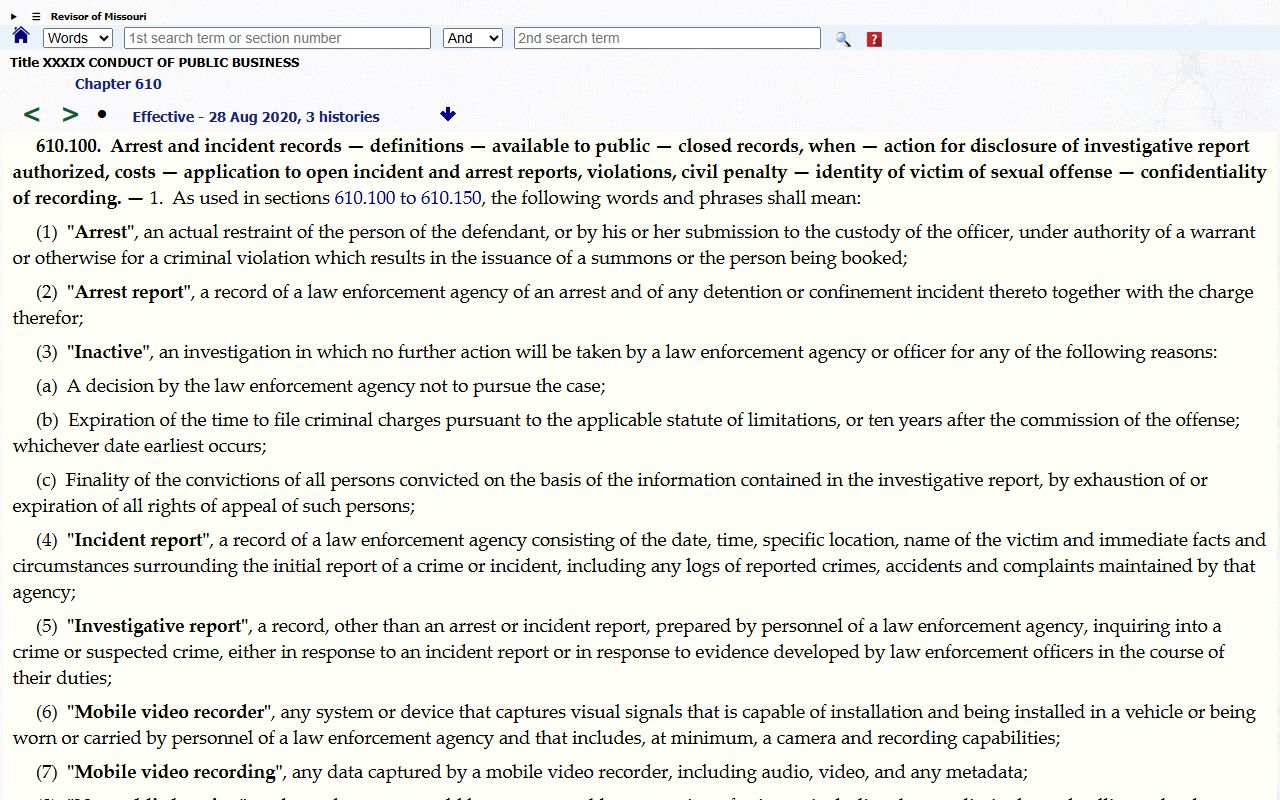
A Chapter 610 request is most useful when the arrest side exists but the court charge has not appeared in the public court index.
Dunklin Charging Documents
Charging documents explain what the prosecutor is asking the court to act on. Missouri cases often use a complaint or information, while an indictment is tied to grand jury action. The charge document may list the offense, statute, class or level, facts alleged by the state, date range, and counts. One arrest can result in one charge, several charges, or no filed charge.
| Document | Filed By | What It Does | Where to Check |
|---|---|---|---|
| Complaint | Prosecutor or law-enforcement-supported filing | Starts or supports a criminal accusation in court. | Case.net and the Circuit Clerk. |
| Information | Prosecuting Attorney | States the formal charge selected by the prosecutor. | Case.net docket and clerk file. |
| Indictment | Grand jury | States a charge returned through grand jury process. | Court file, subject to any sealing order. |
The document type is not the same as the outcome. A complaint or information can be amended, and a charge can be dismissed or reduced later. The final result is found in the disposition, judgment, and sentence entries.
Dunklin Charge Status Terms
Charge status changes are common in criminal cases. A charge filed after arrest may stay pending for weeks or months, move through plea negotiations, be amended to match new facts, be reduced as part of a plea, or be dismissed. A nolle prosequi entry means the prosecutor has declined to proceed on that charge at that time. The exact effect should be read in context with the docket and any final order.
| Status | Plain Meaning | Record Caution |
|---|---|---|
| Pending | The charge has been filed and has not reached final disposition. | Do not read it as a conviction. |
| Amended | The charge text, statute, level, or count has changed. | Compare old and new entries before summarizing the case. |
| Reduced | The charge was lowered, often through plea negotiation or amended filing. | The original arrest allegation may differ from the final conviction. |
| Dismissed | The court or prosecutor ended that charge. | Check whether dismissal was with or without prejudice. |
| Nolle Prosequi | The prosecutor elected not to continue that charge. | Look for refiling limits, related counts, or later docket activity. |
Note: A single Dunklin County arrest can produce several charges, and each charge may have a different status or final result.
Sheriff and Police Channels
The official sheriff page names Nick Darter as Sheriff and lists the Sheriff's Office, jail, dispatch, and fax numbers. The county research found no dedicated Dunklin County sheriff app and no official app-only warrant or inmate lookup. It also found no official online Dunklin jail roster. Those gaps matter because the safest current-custody path is to call the jail or dispatch, then use Case.net only for filed court cases.
Kennett Police may be relevant when the arrest started inside the city. The Kennett Police Department page lists the department at 200 Cedar Street, Kennett, MO 63857, with phone 573-888-4623. City police information can help identify the arresting agency, but formal state court charges still depend on prosecutor filing and court docketing.
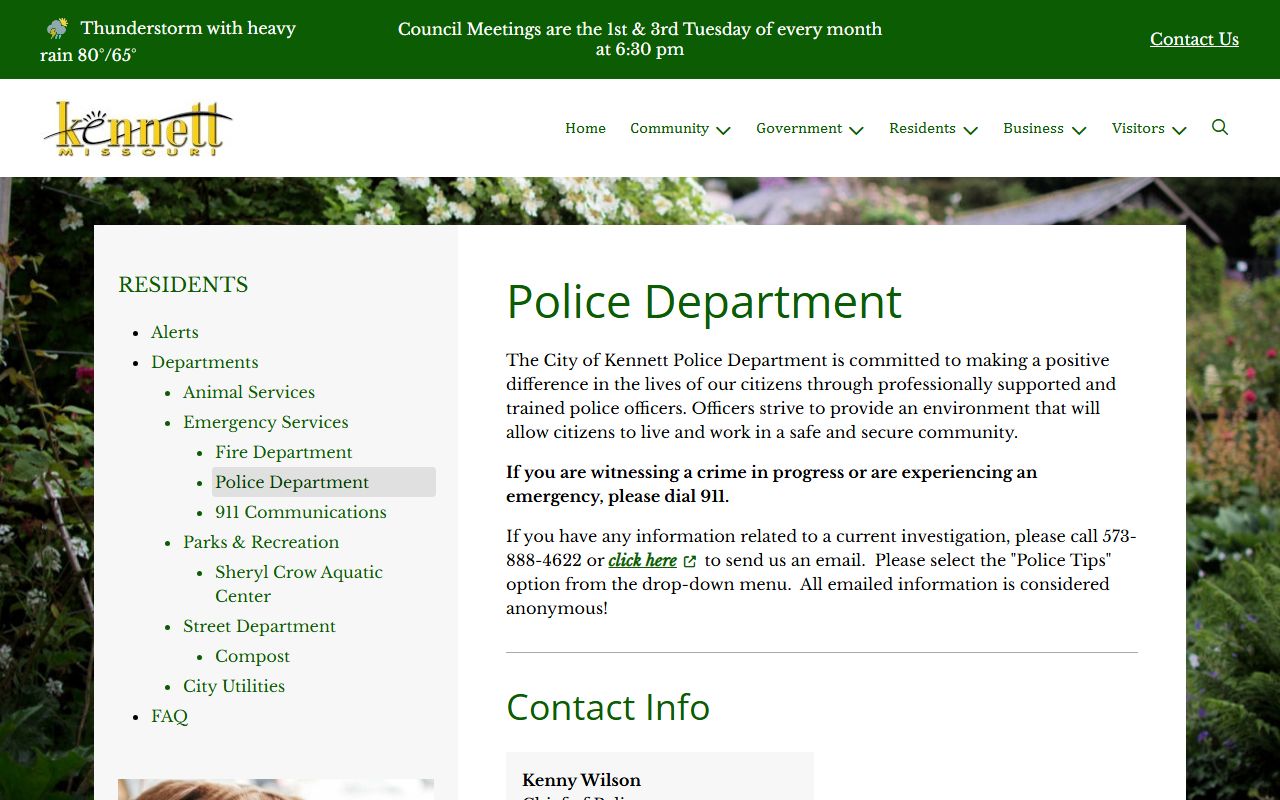
Police contact details are useful for incident-report routing, while Case.net and the clerk remain the better source for formal charge status.
Charges vs Convictions
Arrest records and charge records can be misleading if the reader treats every accusation as a final result. An arrest shows that a person was taken into custody or cited. A filed charge shows that the state has made an accusation in court. A conviction shows that the court entered a guilty result by plea, verdict, or judgment. Those three events can diverge.
| Point | Charge | Conviction |
|---|---|---|
| Meaning | Formal accusation after prosecutor review. | Final guilty result accepted or entered by the court. |
| Proof Level | Based on charging standards and probable cause. | Based on plea, verdict, or judgment. |
| Can Change | Can be amended, added, reduced, dismissed, or refiled. | Can lead to sentence, appeal, probation, or expungement request. |
| Best Field | Charge list and charging document. | Disposition, judgment, and sentence. |
Dunklin Charge Codes and Levels
Charge records usually tie each count to Missouri law through statute text, charge code, or offense description. The level may identify a felony, misdemeanor, infraction, ordinance violation, or traffic-linked criminal charge. The level affects possible penalties, court routing, public access, and expungement analysis. A serious traffic matter such as DWI should be treated as a criminal record issue, not as a simple ticket lookup.
- Felony
- A more serious criminal charge that can carry prison exposure and fuller circuit court handling.
- Misdemeanor
- A lower-level criminal charge that still creates a criminal court record when filed.
- Ordinance violation
- A city-law case that may be handled through a municipal division.
- Disposition
- The final outcome for a charge or case.
- Expungement
- A statutory process that restricts eligible arrest, plea, trial, or conviction records after a court order.
The best reading method is to compare the first charge entry, any amended entries, and the final disposition. That prevents an old arrest label from being mistaken for the charge that actually ended the case.
Statewide Criminal Lookup Limits
Statewide systems can supplement local charge research, but they do not replace the Dunklin County case file. Missouri DOC Offender Search covers active offenders, probationers, and parolees under the Department of Corrections, and it excludes discharged offenders and some confidential or safety-sensitive cases. The sex offender registry is a public registry with its own search fields and contact process. VINELink can help with custody status and victim notification. None of those systems is the same as a court charge record.
The Missouri State Highway Patrol registry contact page is one statewide support source for registry questions. Registry, corrections, jail, and court records should be reconciled carefully because each system updates on its own timetable.
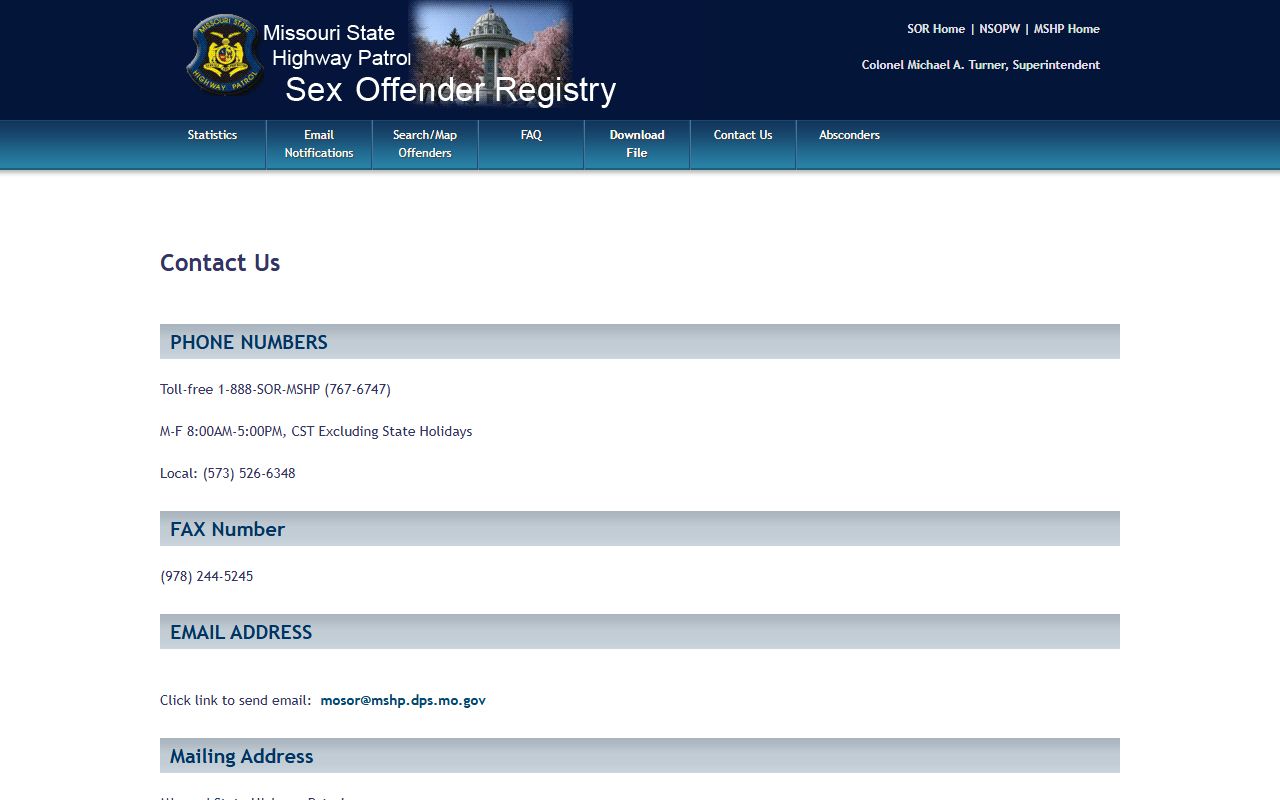
Statewide results may explain supervision or registration status, but the filed charge and court outcome still come from the court record.
Dunklin Arrest Records Expungement
Missouri expungement law can apply to eligible records of arrest, plea, trial, or conviction in municipal, associate circuit, and circuit courts. The petition must be filed in the court where the person was charged or found guilty. For Dunklin County, the practical path is to identify the case in Case.net, contact the Circuit Clerk for filing mechanics, file the petition in the correct court, serve or notify the required parties, and wait for the court's ruling.
| Point | Sealed | Expunged |
|---|---|---|
| Public Access | Closed to ordinary public inspection by rule, law, or court order. | Restricted after a successful statutory petition. |
| Records Affected | May involve juvenile, mental health, protected personal data, or court-ordered closures. | May involve eligible arrest, plea, trial, or conviction records. |
| Limits | Access may still exist for parties or agencies allowed by law. | Class A felonies, dangerous felonies, sex-offender registration offenses, and other excluded offenses are not eligible. |
| Local Contact | Ask the Circuit Clerk for court-file access rules. | Use the court that handled the case for the petition process. |
Restricted Charge Records
Some arrest and charge records are public, but several categories are restricted. Juvenile records are confidential under RSMo 211.321 except where statute or court order permits access. Active investigative reports can be closed under RSMo 610.100. Personal identifiers, protected addresses, minor names, financial account numbers, and sensitive information can be redacted. Sealed and expunged records are not open in the same way as ordinary public case records.
When a record is missing from Case.net, the absence does not prove that no arrest or charge exists. The case may be too new, filed in a municipal division, restricted by law, sealed by order, or held by a different custodian. The sound fallback is to check the sheriff or police agency for the arrest side, the prosecutor for charging context, and the Circuit Clerk for the filed court case.